
Stadium lighting retrofits are often described as simple replacement projects.
In reality, upgrading an operating venue can be more complex than designing lighting for a new field.
The existing stadium may continue to host:
- League matches
- Training
- Concerts
- Community events
- Broadcast productions
- Sponsor activities
- The project team may only have a few nights, weekends or seasonal shutdown periods to complete the work.This makes operational continuity one of the most important design requirements.
Why Phased Retrofit Planning Matters
-
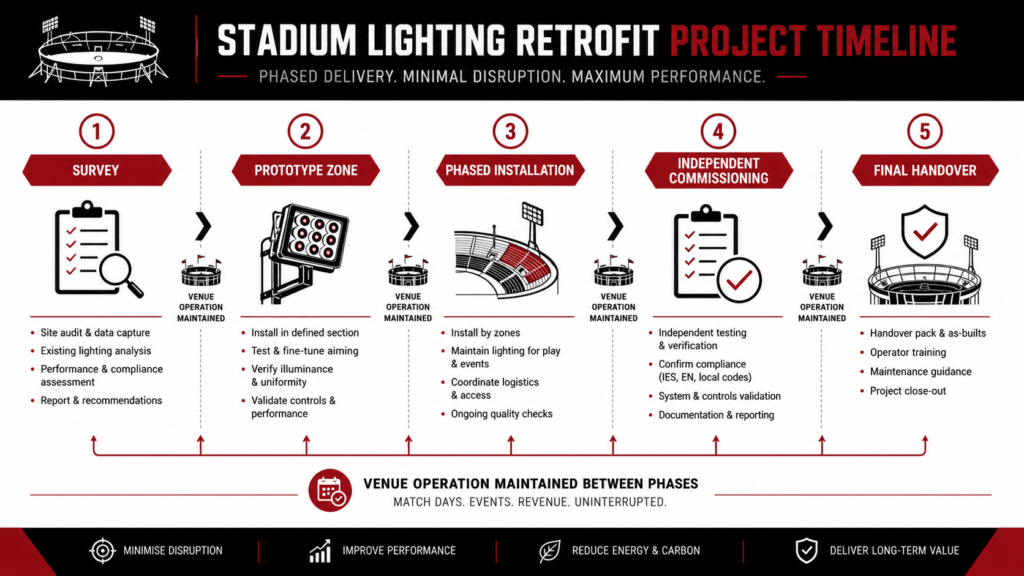
Why Phased Retrofit Planning Matters - A phased retrofit divides the project into controlled sections rather than removing the entire existing system at once.This approach can help the venue:
- Remain operational
- Reduce shutdown time
- Control capital expenditure
- Test new equipment before full conversion
- Coordinate work with the event calendar
- Manage structural and electrical upgrades separately
However, phased work also creates additional engineering challenges.
For a period of time, the venue may operate with a mixture of:
- Existing HID luminaires
- New LED luminaires
- Old and new drivers
- Different control methods
- Temporary circuits
- Partially updated crossarms
Without a clear transition plan, lighting performance and system reliability may become difficult to manage.
Start with a Complete Site Survey
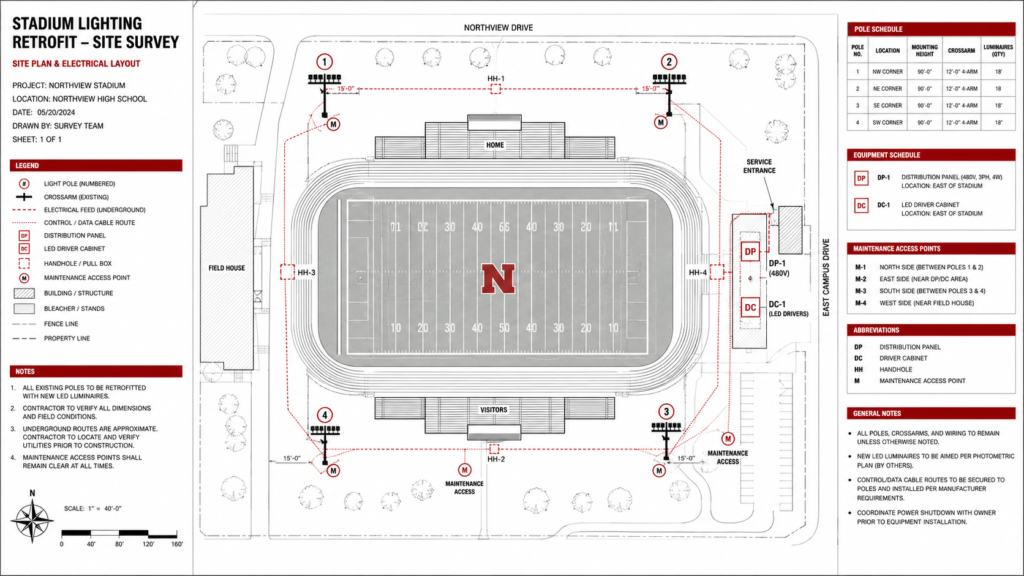
Start with a Complete Site Survey Before selecting replacement luminaires, the project team should document the existing installation.
The survey should include:
- Pole coordinates
- 杆高
- Pole condition
- Crossarm dimensions
- Existing fixture quantity
- Existing fixture weight
- 有效投影面积
- Cable routes
- Circuit capacity
- Distribution panels
- Control equipment
- Driver or ballast locations
- Maintenance access
Photographs should be linked to pole and fixture identification numbers.
This information allows the lighting, structural and electrical teams to work from the same project record.
Existing Pole Capacity Must Be Verified
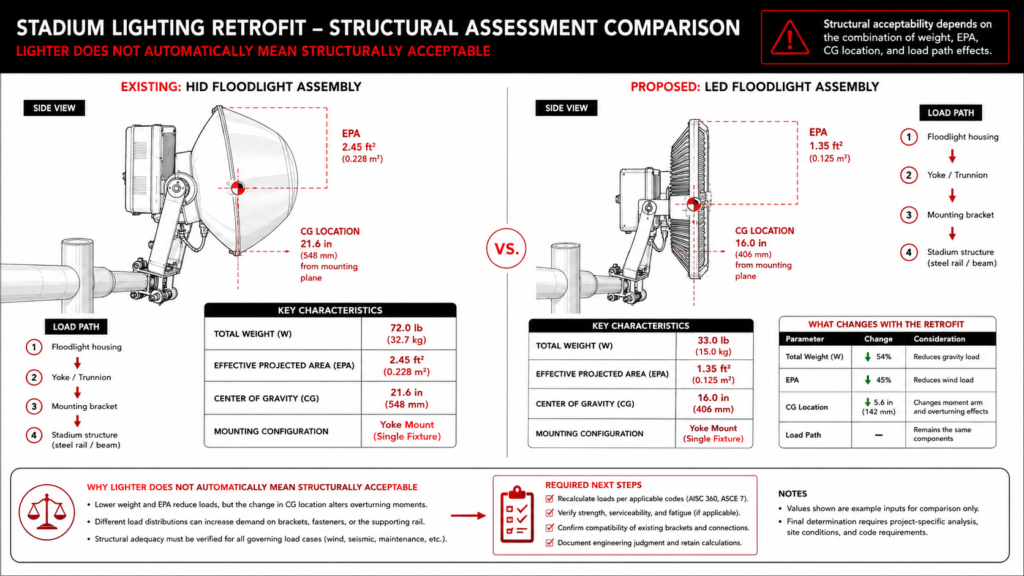
Existing Pole Capacity Must Be Verified LED sports luminaires may be lighter than traditional HID floodlights, but this does not automatically mean the existing structure is suitable.
Structural assessment should consider:
- Total fixture weight
- 有效投影面积
- Wind loading
- 横臂载荷
- Bracket location
- 重心
- Cable and driver boxes
- Corrosion
- Existing structural damage
A lighter luminaire with a larger frontal area may create greater wind loading than expected.
The pole and crossarm should therefore be assessed as part of the full assembly.
Do Not Select Wattage Before Reviewing Geometry
Retrofit projects are constrained by existing pole locations.
The lighting designer cannot freely relocate every pole to create an ideal arrangement.
The selected optical system must work within:
- Existing mounting height
- Existing setback
- Existing pole spacing
- Available crossarm positions
- Allowed aiming angles
- Surrounding property boundaries
The correct retrofit luminaire is not necessarily the highest-output model.
A lower-weight product with multiple optical options may offer a better solution when the original pole arrangement limits aiming flexibility.
Plan the Electrical Transition
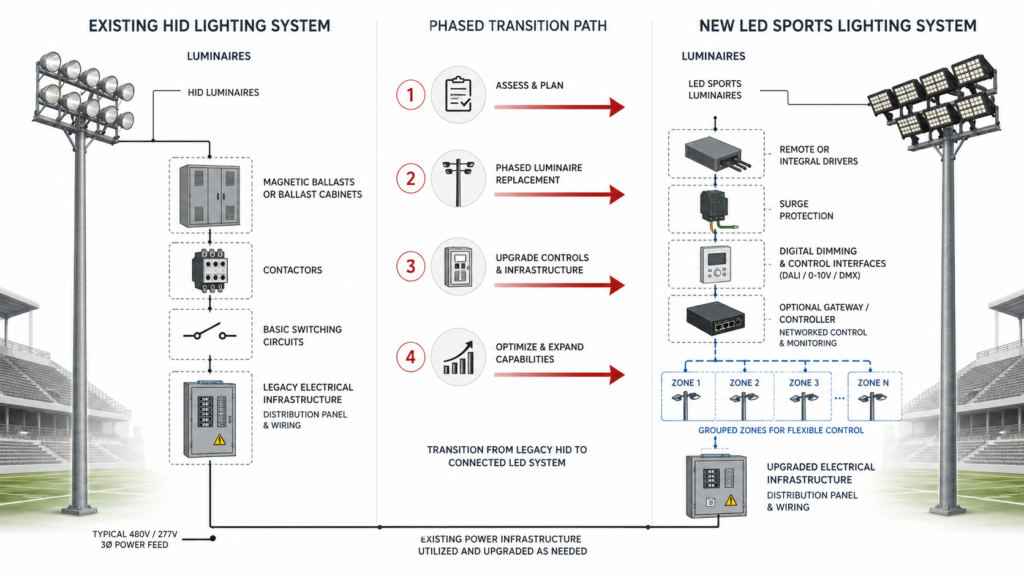
Plan the Electrical Transition Traditional stadium lighting systems may use:
- Remote magnetic ballasts
- High-voltage starting circuits
- Centralized contactors
- Limited switching zones
- Separate emergency circuits
An LED retrofit may introduce:
- Electronic drivers
- Dimming
- Digital control
- Network gateways
- Individual addressing
- 浪涌保护
- Remote driver cabinets
The electrical design should define which existing components will be:
- Reused
- Modified
- Bypassed
- Removed
- Replaced
Temporary operation should also be planned.
The venue may need clearly defined procedures for switching between old and new lighting zones during construction.
Separate Competition Lighting from Entertainment Lighting
Where a venue introduces RGB or RGBW effects, the entertainment system should not compromise the reliability of the primary white-light system.
The project documentation should clarify:
- Separate power supplies
- Separate control channels
- Default white-light state
- Communication failure behavior
- 本地手动覆盖
- Emergency operating mode
The competition lighting must remain available even if the entertainment controller, network or show programming is unavailable.
Commission Each Phase Independently
Every completed phase should be treated as a temporary but operational lighting system.
The project team should verify:
- Fixture installation
- Mechanical locking
- Electrical connections
- 驱动程序配置
- Control addresses
- Initial aiming
- Operating modes
- Emergency behavior
- Field illuminance
- Visual consistency with remaining fixtures
Any changes should be recorded immediately.
Waiting until the final phase to update drawings and aiming records creates unnecessary risk.
Maintain a Living As-Built Record
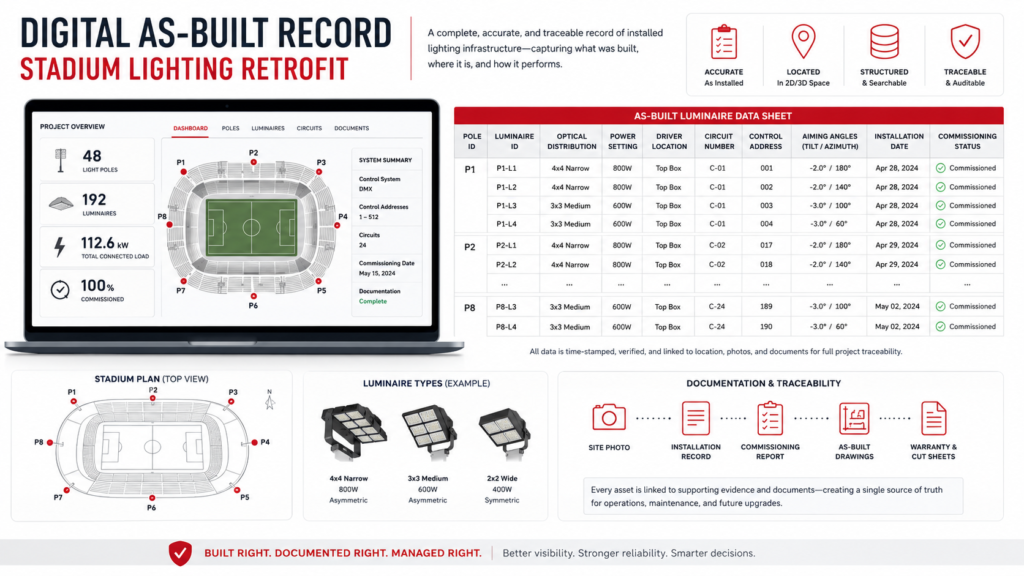
Maintain a Living As-Built Record A phased retrofit may continue for months or years.
The project therefore needs a continuously updated digital record containing:
- Pole IDs
- Luminaire IDs
- Product model
- 光分配
- Power setting
- Driver location
- Circuit number
- Control address
- Aiming angles
- Installation date
- Commissioning status
This information supports both project completion and future maintenance.
A Successful Retrofit Protects Venue Operations
The best retrofit is not simply the one that replaces the old luminaires fastest.
A successful project should:
- Preserve safe venue operation
- Reduce disruption
- Maintain lighting performance during transition
- Control structural and electrical risk
- Provide traceable installation data
- Support future maintenance
For operating stadiums, project planning is part of the lighting solution.
FAQ
Yes, but the project normally requires phased construction, temporary operating procedures and independent commissioning of each completed section.
Can existing stadium poles always be reused?
No. Pole and crossarm capacity must be reviewed based on weight, wind loading, effective projected area, corrosion and mounting configuration.
 English
  한국어
한국어  Español
  简体中文
简体中文  Français
  Deutsch
  العربية
  日本語
日本語