
For many years, sports lighting projects were judged mainly by illuminance, uniformity and energy savings. Those measures remain essential, but they no longer describe the complete performance of an outdoor venue.
As more facilities are built near homes, roads, hotels, schools and mixed-use developments, project owners must also consider what happens outside the playing surface. Can players see an intense luminous face while following a high ball? Does light cross the property boundary? Is the rear side of the pole producing unnecessary backlight? Can output be reduced when the venue is used only for training?
Low glare is moving from a premium feature to a project requirement
Planning authorities, residents, facility managers and sports users increasingly evaluate the whole lighting system rather than the fixture wattage alone. This changes the project conversation from “How many lumens?” to “How much useful light reaches the target, and where does the remaining light go?”
The shift affects compact racket-sport courts, school fields, municipal sports parks, regional training grounds and professional stadiums. The engineering scale changes, but the underlying issue is the same: optical distribution, pole geometry, aiming and controls must work together.
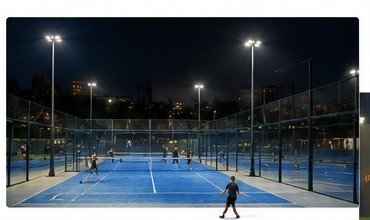
Padel shows why lighting control matters
Padel is a useful entry point because the sport is expanding rapidly and many new courts are located close to sensitive boundaries. The International Padel Federation’s 2025 report described continued growth in players, courts and participating countries.
Many courts are introduced into tennis clubs, hotels, residential developments, schools and converted commercial sites. Compared with a stadium inside a large sports complex, a padel court may sit only a short distance from homes, parking areas or roads.
Players also track a fast ball at high viewing angles. Glass enclosures can introduce reflections, while relatively low mounting heights place luminaires closer to normal sightlines. A court may therefore reach the required average illuminance and still produce an uncomfortable result if fixture brightness, tilt or pole positions are poorly controlled.
Low glare is not a single product parameter
“Low glare” is often used as a product claim, but final visual comfort is created by the relationship between the luminaire and the site. Relevant factors include optical distribution, visible luminous area, mounting height, setback, tilt, shielding, background brightness and the observer’s position.
For outdoor sports projects, the design team should identify the critical observers: a padel player following a lob, a goalkeeper facing a sideline pole, a baseball player tracking a high ball, a spectator opposite a floodlight array, a driver approaching the site or a resident looking toward the venue.
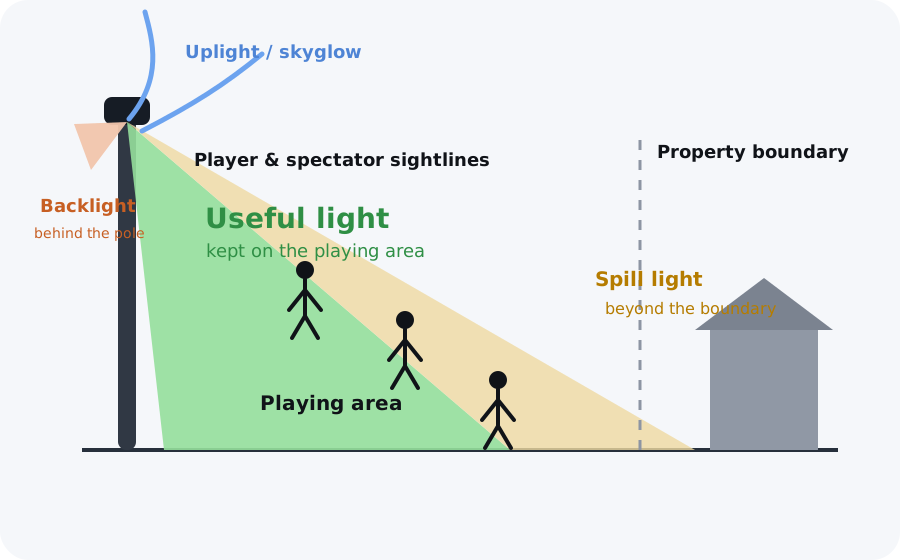
Four unwanted-light risks must be separated
1. Player and spectator glare
A bright source inside the normal field of view can reduce visual comfort and make it harder to track a ball, identify another player or judge speed and distance.
2. Spill light
Spill light reaches areas outside the intended playing surface, including neighbouring land, roads, façades and residential windows.
3. Backlight
Backlight leaves the rear side of a lighting position instead of travelling toward the target area. It becomes especially important when poles are close to a boundary.
4. Uplight and skyglow
Direct or reflected light entering the sky contributes to the brightening of the night environment. Full-cutoff or tightly shielded solutions may be needed where ecological or planning requirements are strict.
These risks are related, but they are not interchangeable. A visor that controls backlight may not solve a player sightline problem. A full-cutoff fixture may reduce uplight but still require careful aiming to avoid excessive source brightness from a particular viewing direction.
How the same principle applies across the sports lighting market
Padel, tennis and similar courts
Priorities include player sightlines, uniform court coverage, controlled tilt, low boundary spill and practical mounting on standard court poles.
Community fields and recreation parks
Municipal and school projects often balance playable light levels with neighbourhood acceptance, operating-hour limits and budget constraints.
Training grounds and regional stadiums
Designs typically combine near-, mid- and far-zone optics rather than forcing one beam distribution to cover the whole field.
High-mast and broadcast venues
Vertical illuminance, flicker control, camera-facing uniformity, aiming records, driver location and structural loading become part of one system decision.
One design principle, four venue scales
Low-glare control changes with pole height, setback and observer position
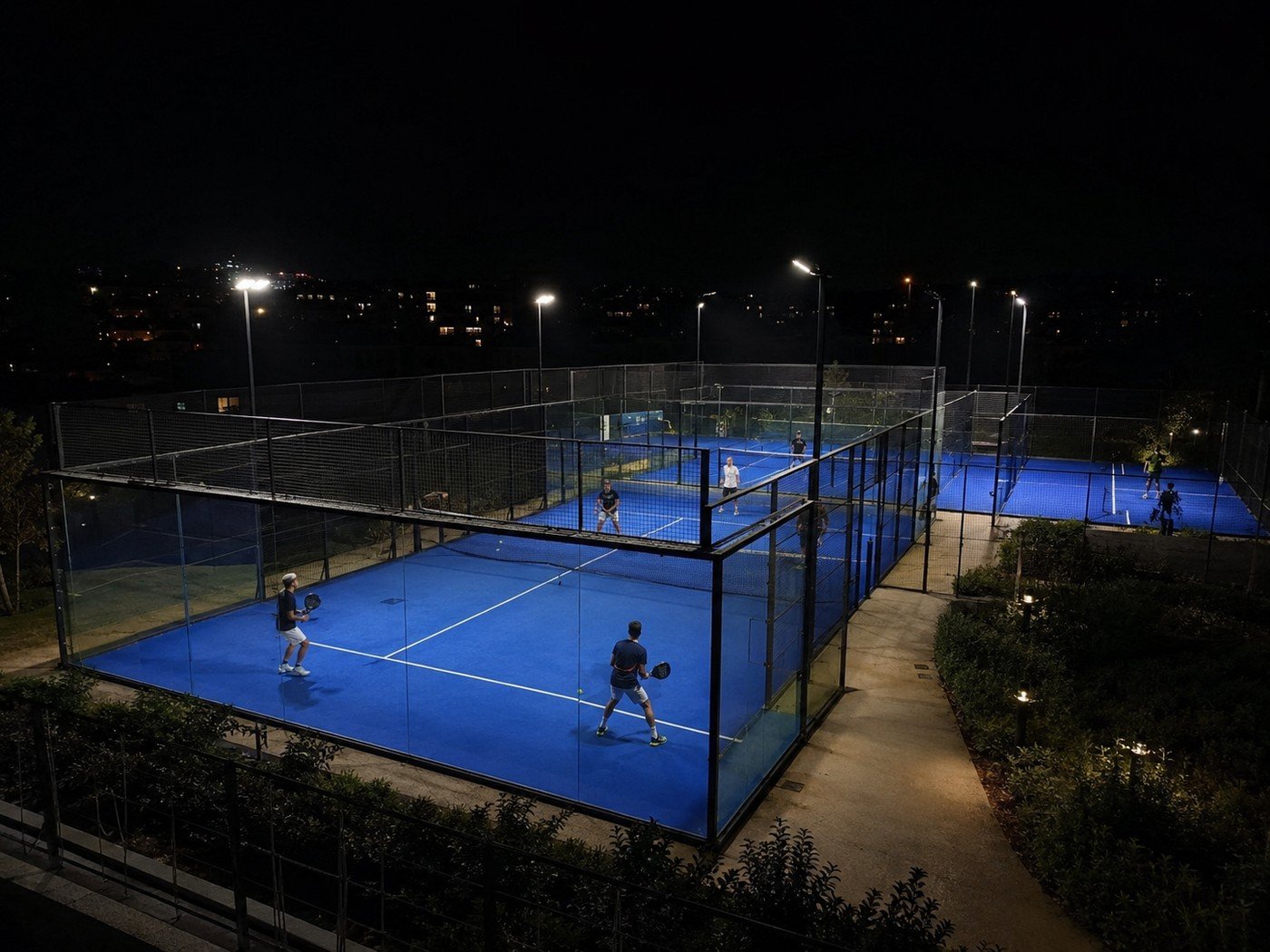
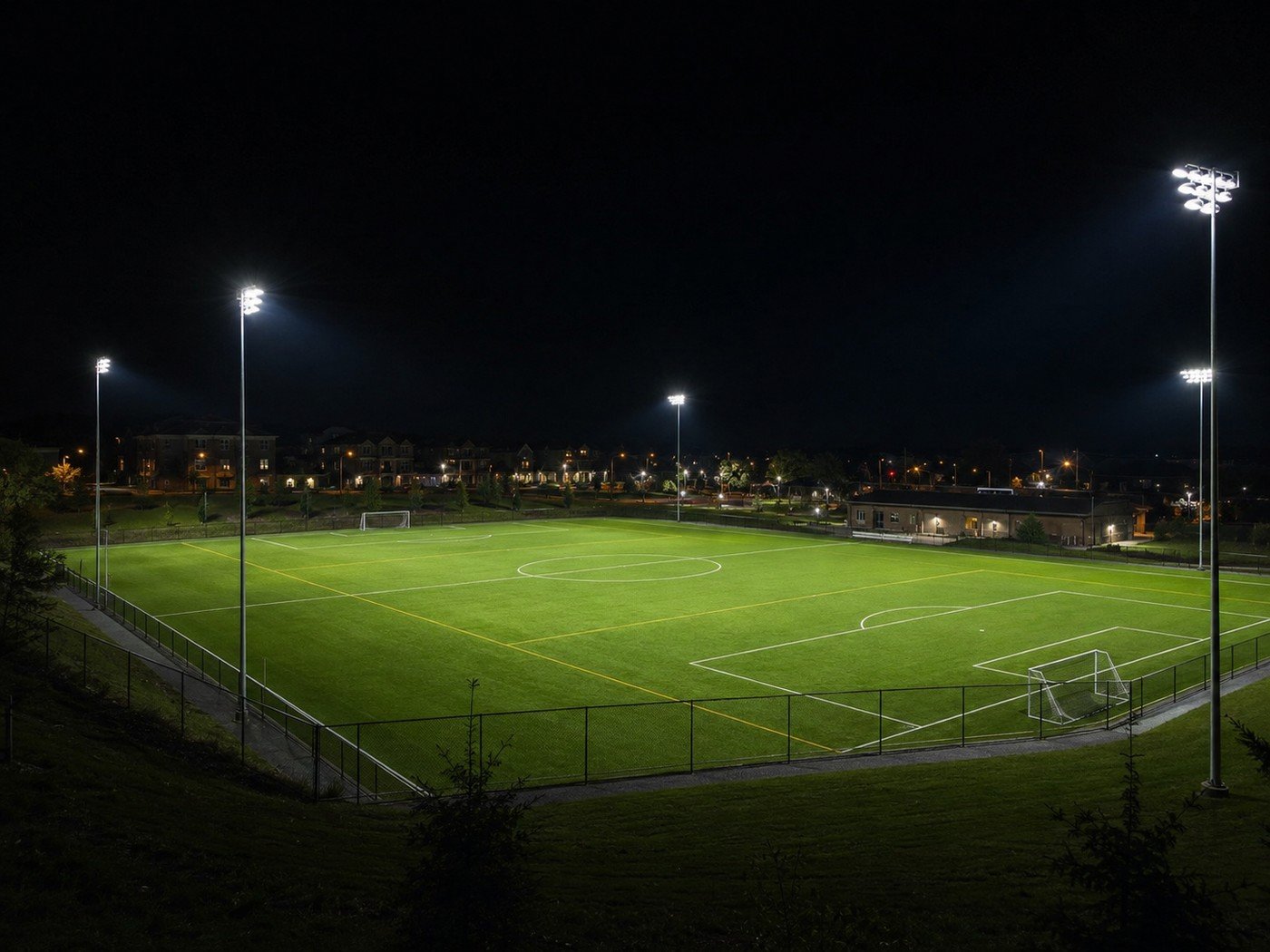
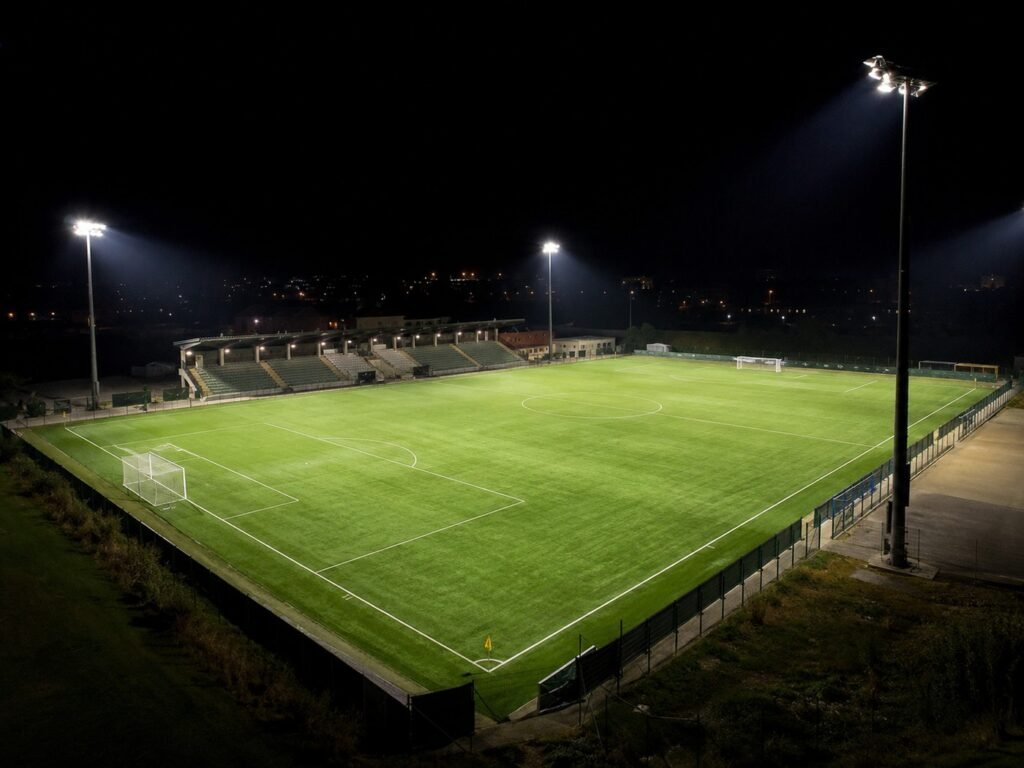
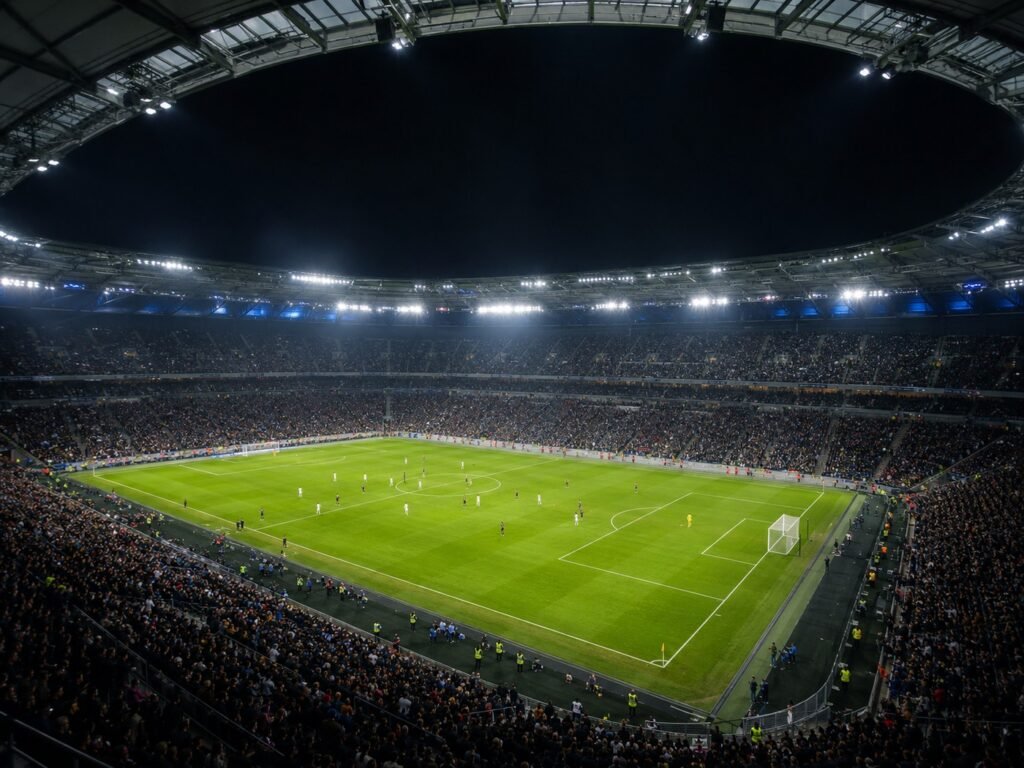
Application scenes are illustrative. Final fixture quantities, pole layouts and aiming must follow the project photometric design.
Modular platforms such as FL26 can also support contractors and distributors handling different field sizes, power levels and optical requirements. The product structure may simplify configuration, but the final selection must still follow the field geometry and performance target.
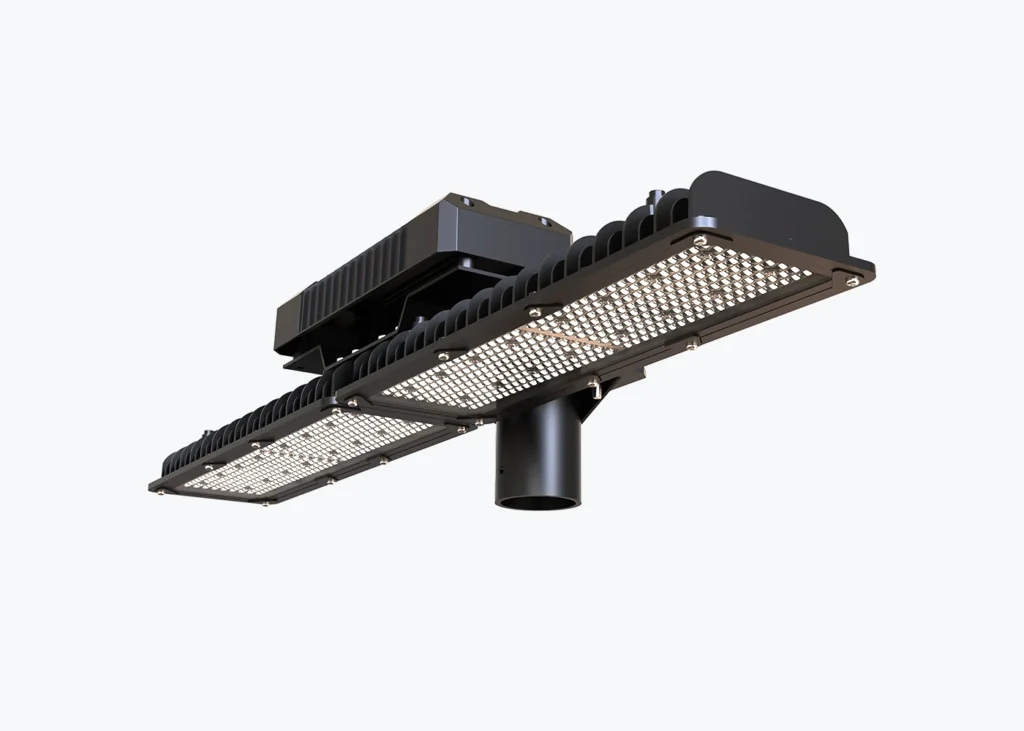
PL08: one practical court-lighting example—not the whole solution
PL08 is relevant to this topic because it was developed around court-oriented optical control, flexible mounting and optional spill-light accessories. It illustrates how a product platform can support a low-glare design, but it does not replace the photometric and installation work required for the project.
PL08 LED Tennis & Padel Court Light
240–500W configurations, up to 165 lm/W, IP66 protection, multiple optical options, optional visors and flexible top- or U-bracket mounting.
Appropriate use depends on court dimensions, pole layout, mounting height, lighting class and surrounding boundary conditions.
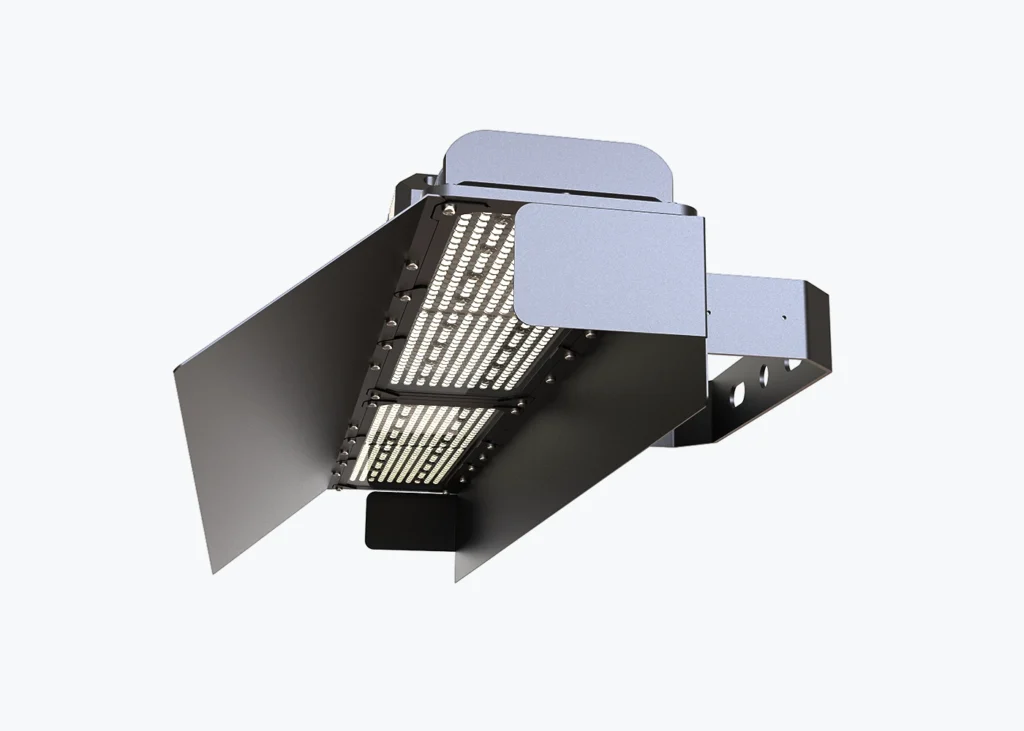
Match the bracket to the pole and aiming requirement
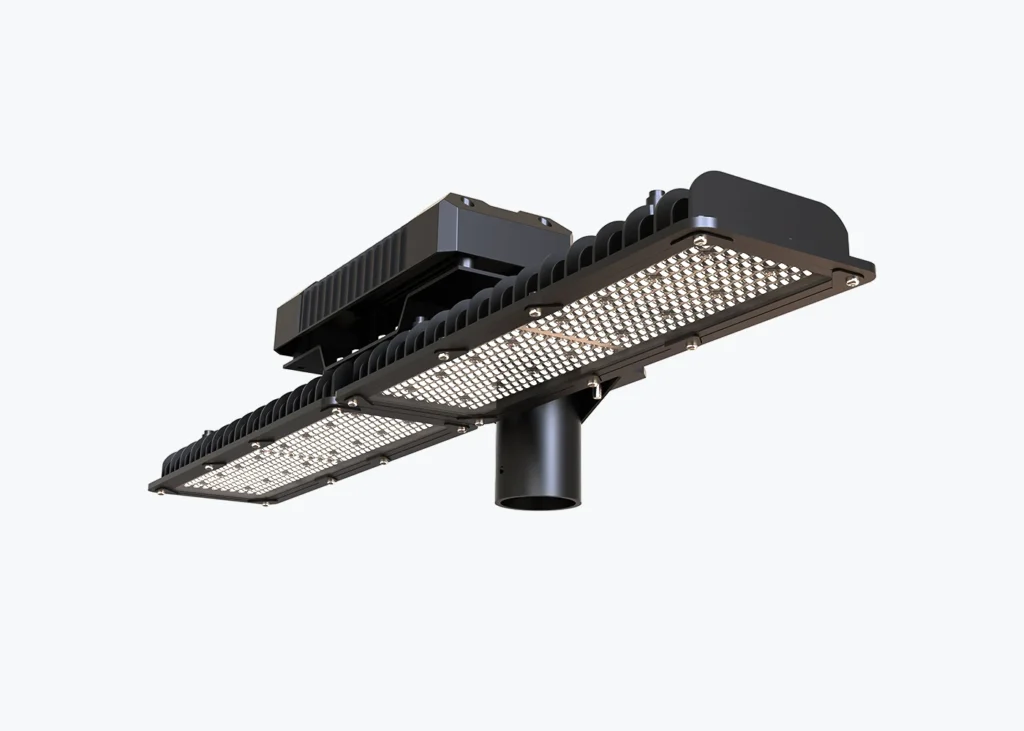
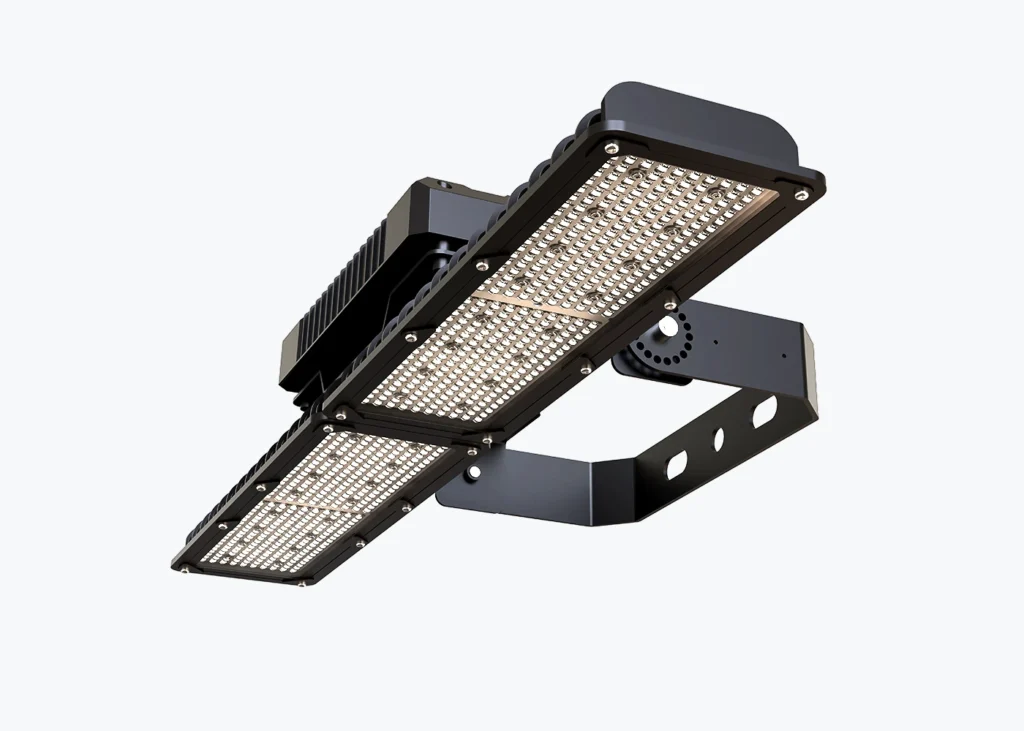
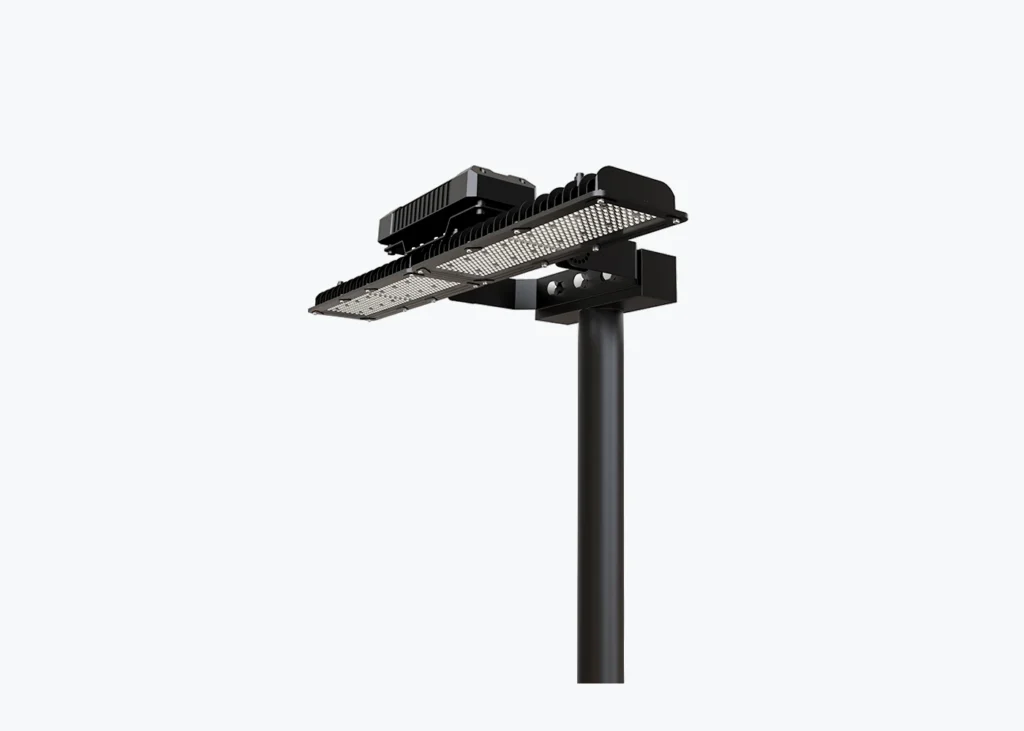
Bracket choice influences aiming range, mechanical loading and installation access. It should be confirmed together with the pole and crossarm design.
Six principles for a low-glare sports lighting design
Start with the field and surroundings
Model accurate dimensions, pole positions, nearby buildings, roads, spectator zones, cameras and property boundaries before choosing a fixture.
Match beams to target zones
Assign near-, mid- and far-zone targets. One beam angle for every luminaire rarely gives the best result on a complex field.
Control visible source brightness
Evaluate the luminous surface from critical observer positions. Use shielding only after checking its impact on useful light and uniformity.
Avoid solving throw with excessive tilt
Reconsider pole height, setback and optics before increasing tilt angles that may expose the luminous face to players or residents.
Use controls as part of the optical strategy
Create separate competition, training, maintenance and security scenes so full output is used only when the activity requires it.
Verify aiming after installation
Record fixture IDs and final angles, measure illuminance, inspect critical sightlines and confirm boundary performance after dark.
From calculation to installed performance
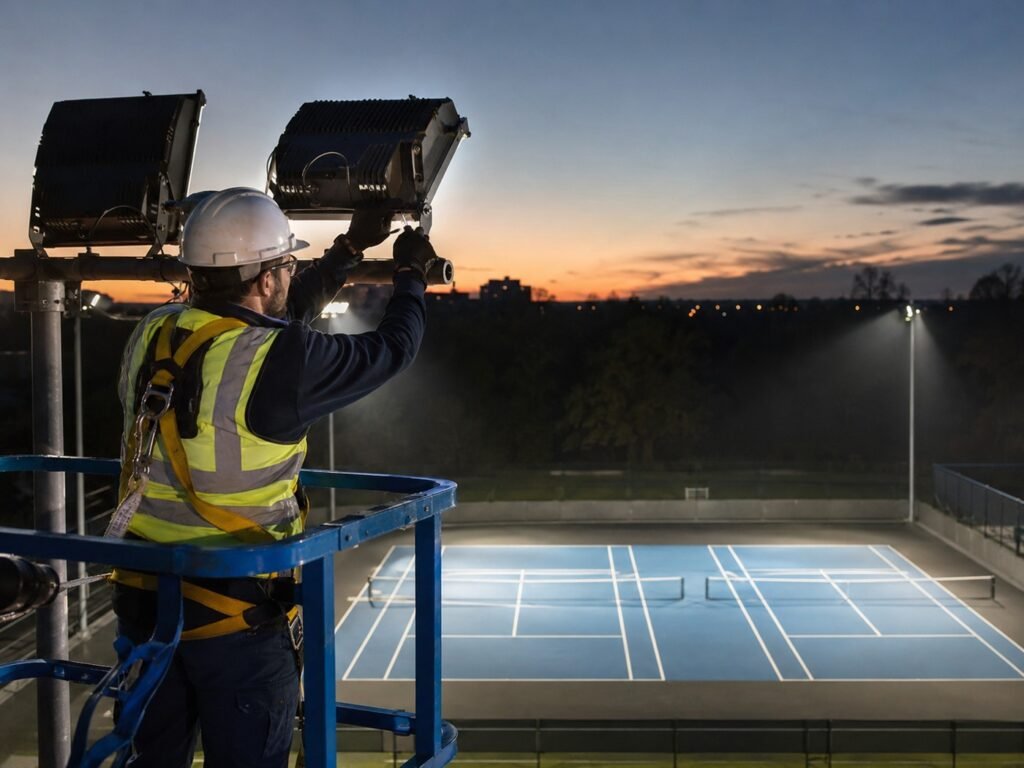
Low glare still depends on accurate aiming and commissioning
Each luminaire should be identified, aimed and recorded against the design. On-site checks should include playing-area illuminance, critical sightlines, boundary conditions and every control scene.
- Confirm horizontal and vertical aiming angles
- Inspect glare from player and spectator positions
- Measure boundary light after dark
- Record final fixture IDs and control modes
Product selection should follow the project—not the opposite
ZC Lighting uses different sports-lighting platforms because a padel court, a community football field and a professional stadium do not create the same optical, structural or maintenance problem.
| Project type | Primary design priority | ZC product example | Selection reminder |
|---|---|---|---|
| Padel and tennis courts | Player sightlines, court uniformity, boundary spill | PL08 | Check pole height, court orientation, glass reflections and neighbouring properties. |
| Community fields near sensitive boundaries | Full-cutoff control, reduced upward light and operating-hour management | FL20 | Confirm that the selected distribution reaches the field without forcing unsuitable tilt. |
| Multi-field and flexible contractor projects | Power and optical configurability, maintenance and inventory flexibility | FL26 | Use common hardware only where the photometric result remains suitable for each field. |
| Training grounds and regional stadiums | High output, value, optional broadcast performance and harsh-environment durability | FL18 | Coordinate optics, CRI/TLCI, flicker requirements and control modes with the venue level. |
| Professional and high-mast stadiums | Long throw, vertical illuminance, aiming accuracy and maintenance planning | FL09 | Review structural load, driver location, camera directions and commissioning access. |
These are application examples rather than automatic prescriptions. Final selection should be supported by photometric calculation, structural review, environmental restrictions, installation conditions and the required level of competition or broadcast.
A better definition of sports lighting quality
High-quality sports lighting provides enough light for the activity while controlling where the light travels, what important observers can see, how the system behaves in different operating modes and how accurately the design can be installed and verified.
The growth of padel creates a visible opportunity for specialised court lighting, but the wider lesson applies throughout the market. Community projects need neighbourhood acceptance. Training facilities need controllable and maintainable systems. Professional stadiums need reliable optical and broadcast performance under complex viewing conditions.
Frequently asked questions
What causes glare in sports lighting?
Glare is affected by source brightness, visible luminous area, mounting height, pole position, aiming angle, optical distribution, background brightness and the observer’s viewing direction. Fixture wattage alone cannot describe it.
How can spill light from a sports field be reduced?
Use suitable pole setback, controlled or asymmetric distributions, limited tilt, accurate aiming, appropriate visors or shields and operating controls. Boundary calculations should be included before installation.
Is PL08 only suitable for padel courts?
PL08 is designed for tennis, padel and similar compact-court applications. Suitability depends on court dimensions, mounting height, pole layout, required lighting class and surrounding boundary conditions.
Which ZC product is suitable for a professional stadium?
FL09 and FL18 are relevant examples for larger sports venues. The decision depends on output, throw distance, broadcast requirements, structural limits, maintenance strategy and project budget.
Does a low-glare floodlight guarantee a low-glare installation?
No. Final performance depends on the complete system, including pole geometry, optics, fixture orientation, aiming, shielding, controls and installation accuracy.
Sources and further reading
- International Padel Federation: FIP World Padel Report 2025
- Lawn Tennis Association: Padel Court Construction Guidance Note 2025
- Institution of Lighting Professionals: Guidance Notes for the Reduction of Obtrusive Light
- DarkSky International: Outdoor Sports Lighting
Planning a Padel Court, Community Field or Stadium Lighting Project?
Share the venue type, field dimensions, competition level, pole positions, mounting heights, nearby boundaries and control requirements. ZC Lighting can support product selection, IES files, photometric simulation, beam planning and application-specific recommendations.
 English
  한국어
한국어  Español
  简体中文
简体中文  Français
  Deutsch
  العربية
  日本語
日本語