
预计阅读时间: 17 分钟
选择LED体育场灯,并非仅仅是寻找瓦数最高、流明输出最大或光束角最窄的灯具那么简单。.
体育场照明系统必须综合考虑场地尺寸、安装位置、灯杆高度、比赛级别、摄像机拍摄角度、周边环境、电力基础设施以及长期维护计划等因素。.
正确的问题不应是:“哪盏体育场灯最亮?”而应是:“哪种灯具、光学系统、安装位置、光束角度、控制装置和安装方法的组合,既能满足项目要求,又能确保眩光、光照均匀度、结构荷载和长期运行成本均在可接受范围内?”
官方足球照明指南区分了转播场馆与非转播场馆的要求,并考虑了球员、裁判、观众、转播方以及不同安装方案的需求。因此,体育场照明应作为一个完整的系统进行评估,而非仅作为孤立的灯具规格来考量。.
快速解答:选择体育场照明灯前应检查哪些事项?
在选择灯具之前,请先明确项目的以下七个方面:
| 选择因子 | 需要回答的问题 |
| 场地要求 | 该场地是用于训练、比赛还是专业转播? |
| 场几何 | 场地尺寸、立柱位置、立柱高度和退让距离分别是多少? |
| 光度学目标 | 对照度、均匀度、眩光和垂直照度有哪些要求? |
| 光分配 | 哪些区域需要窄、中、宽或非对称的光分布? |
| 固定装置与结构 | 该结构能够承受多大的重量、EPA值、支架布置方式以及驱动器位置? |
| 电气与控制 | 需要哪些电压、调光、场景控制、浪涌保护和通信接口? |
| 安装与维护 | 灯具将如何进行安装、调光、维护、测试和验收? |
项目要求 → 现场几何 → 光度测量目标 → 光学系统 → 固定装置结构 → 控制系统 → 验证
1. 从项目入手,而不是从灯具入手
同一款LED体育场灯,并不一定同样适合学校训练场、市政体育场和专业转播场地。项目的级别决定了哪些照明特性最为重要。.
| 项目层面 | 典型的场地 | 主要遴选优先事项 |
| 培训与社区应用 | 学校、俱乐部、社区运动场 | 一致性、成本控制、操作简便、维护方便 |
| 比赛场地 | 市政体育场、职业俱乐部、地区性场馆 | 防眩光、更高均匀度、灵活的光学设计、系统可靠性 |
| 播出场所 | 职业体育场馆和电视转播赛事 | 垂直照度、摄像机方向均匀性、色彩表现、频闪控制、场景管理 |
在联系供应商之前,项目团队应明确以下内容:
- 这项运动及其竞技水平
- 该场馆是否将举办电视转播赛事
- 适用的联合会、赛事、市政或客户要求
- 当前需求及未来可能的升级
- 操作模式包括训练、比赛、清洁、安保和娱乐等
不应将社区场地不必要地指定为转播场地。同时,预计未来将进行电视转播的场地,不应选择日后无法满足所需垂直照度、瞬时光照性能或控制要求的系统。.
2. 确定场和安装几何形状
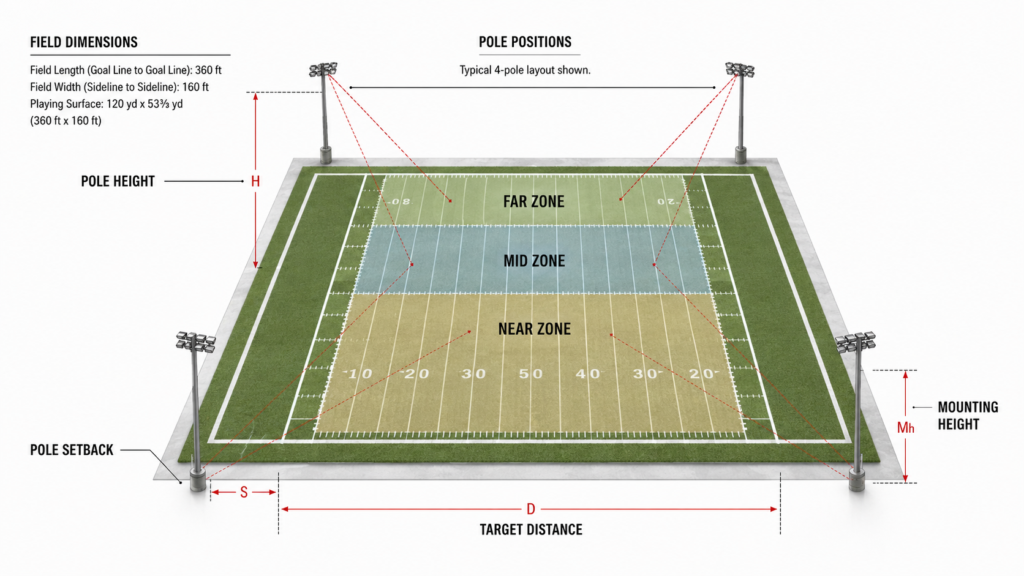
如果不了解体育场照明灯的安装位置以及需要照射的区域,就无法准确选择合适的照明灯。.
所需的项目信息应包括:
- 游乐区尺寸
- 电线杆数量及位置
- 杆高
- 立柱与比赛区域之间的间距
- 屋顶安装或杆上安装方式
- 现有或新的安装结构
- 各安装点到目标区域的距离
- 看台、屋顶、记分牌、摄像机平台及其他障碍物
- 附近的道路、房屋、房产或敏感边界
- 维护与起重作业通道
仅凭灯杆高度并不能决定光束角
人们通常认为,特定的灯杆高度会自动对应特定的光束角。但在实际应用中,这一决定还取决于水平后退距离、目标距离、灯具在横臂上的安装位置、指向角、灯具朝向、所需的光束重叠范围以及溢光限制。.
因此,两个均设有25米高灯杆的球场,如果其中一个球场的灯杆靠近边线,而另一个球场的灯杆与边线间距大得多,则可能需要采用不同的光学组合。.
灯杆的数量也会影响照明质量
四杆布局虽然可以减少基础和电气连接点的数量,但每根灯杆通常需要覆盖更广的场地范围。六杆或八杆布局可以提供更多的照明方向,并减轻单个安装点的负担,但也会增加在结构、布线、安装和维护方面的要求。.
并没有一种放之四海皆准的最佳布局。正确的布局取决于可用土地、场地大小、球道分布、摄像机方向、结构成本、眩光以及比赛水平。.
3. 设定所需的照明性能
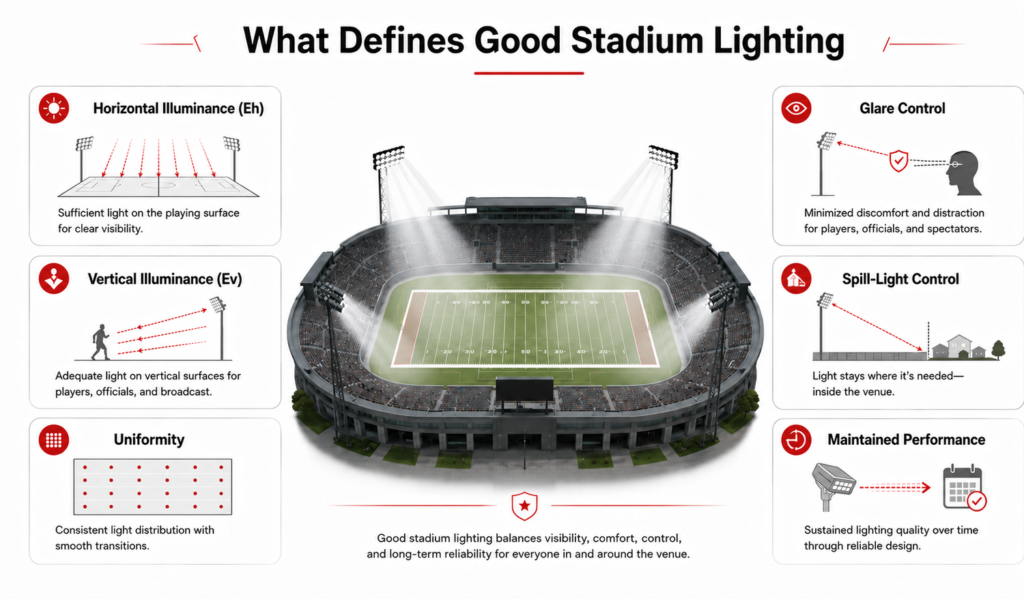
在明确项目和几何形状后,应制定可量化的性能要求。平均照度不应是唯一的验收标准。.
| 公制 | 这表明了什么 |
| 平均水平照度 | 整个比赛场地的整体照明 |
| 均匀性 | 较暗区域与较亮区域之间的关系 |
| 垂直照度 | 从选定的视角或摄像机方向观察到的角色和物体的可见性 |
| 眩光等级 | 由照明系统引起的视觉不适或视野受阻 |
| 漫射光 | 光线照射到预定游戏区域以外的区域 |
| 背光与上照光 | 从灯具后方或朝向天空发出的光 |
| 色彩表现 | 人物的外貌、制服、场地标记及物品 |
| 时间光性能 | 在人眼观察和摄像机录制下的照明行为 |
| 维护系数 | 系统输出随时间推移的预期下降幅度 |
标称流明值并不能证明实际性能
即使一盏灯具的流明输出很高,如果其光分布与场地几何形状不匹配、过多光线照射到比赛区域之外、调光角度导致眩光、窄光束产生亮斑、场地缺乏足够的横向照明,或者在重要摄像机拍摄方向上的垂直照度较弱,其照明效果仍可能不佳。.
流明描述的是从灯具发出的光量。它并不能反映有多少有效光到达所需的测量点。因此,两盏功率和流明输出相似的灯具,在照度分布、均匀度、眩光和溢光方面的表现可能截然不同。.
考虑保持性能
项目规范应明确说明所需数值是初始值还是维持值。照明计算中可能会应用一个维护系数,以考虑流明衰减、灰尘积聚、环境条件、清洁间隔以及维护措施等因素。.
4. 在确定功率之前先选择光学元件
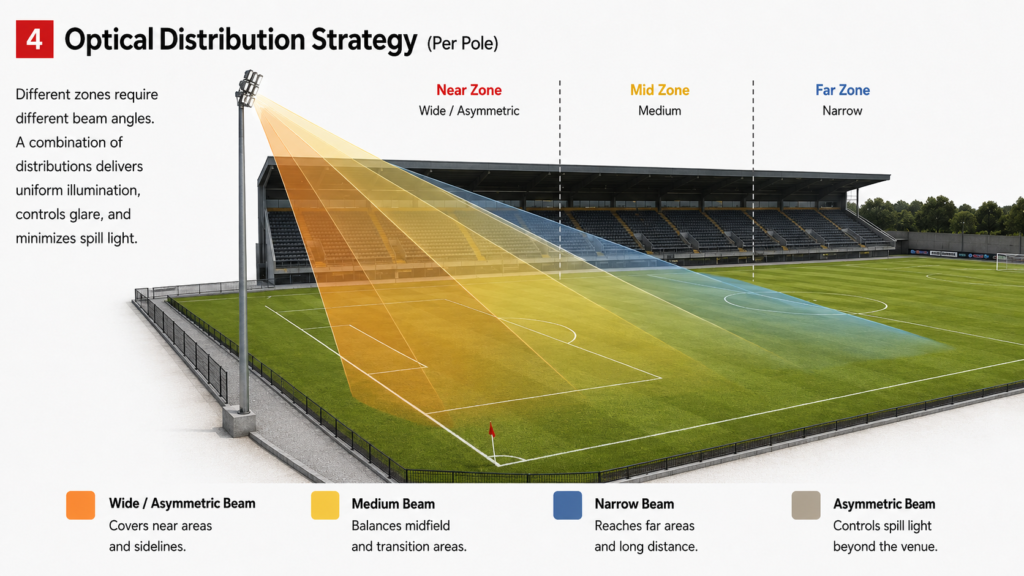
光分布决定了光线照射的位置。瓦数决定了电功率输入;它并不决定光线是否投射到场地的正确位置。.
| 目标区域 | 常见的光学要求 |
| 远区 | 可控的窄角或长投射分布 |
| 过渡区 | 具有有用重叠的中等分布 |
| 邻近区域 | 更宽或不对称的分布 |
| 边线与界线 | 可控的分布,可减少超调 |
| 监控区域 | 支持垂直照度的交叉照明 |
| 住宅区界限 | 用于控制背光和溢光的光学元件和遮光结构 |
更窄的并不总是更好的
极窄的光束虽然能提供强烈的中心光强,但也可能产生局部亮点,对微小的瞄准误差更为敏感,在相邻光束之间形成可见的对比,需要更精确的调试,而且如果瞄准过于激进,还会增加眩光。.
更宽的光学系统可以在某些区域提高覆盖范围,但如果安装位置不当,可能会导致更多光线照射到目标区域之外。我们的目标是实现一种可控的组合,使光束在近、中、远三个区域之间产生适当的重叠。.
仅靠光束角的名称是不够的
两款均标注为“20°”的产品,其光强分布未必相同。请比较其光度曲线、坎德拉分布、对称性或非对称性、主光束外的光分布、背光和上照光、搭配遮光板或护罩时的性能,以及项目模拟中使用的 IES 或 LDT 文件。.
5. 选择合适的灯具结构
LED体育场照明灯具提供一体化、模块化、半模块化和远程驱动器等多种配置。没有哪种架构天生就更优越;每种架构都能解决不同的项目限制。.
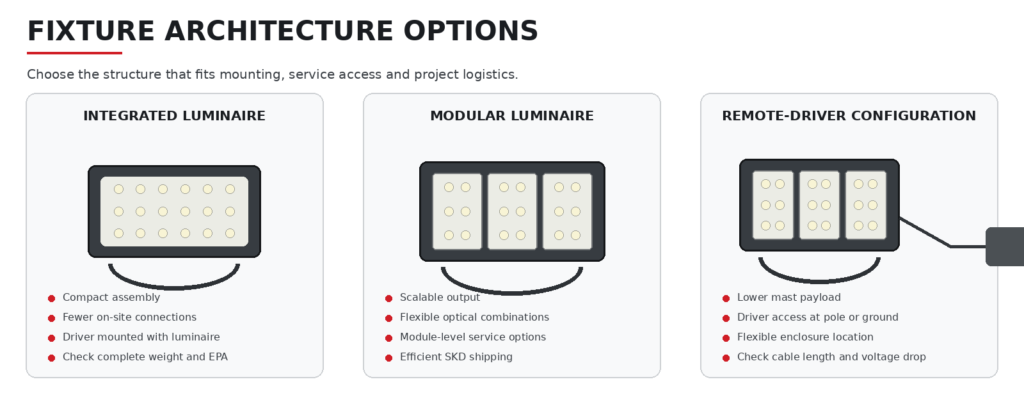
| 灯具结构 | 在以下情况下更合适: | 评估事项 |
| 一体化灯具 | 紧凑的安装和简化的组装是首要任务 | 重量、维护便利性、散热设计、驱动器更换 |
| 模块化灯具 | 需要灵活的输出、光学系统、装配或配置 | 模块接线、独立运行、瞄准、备件 |
| 半模块化系统 | 需要在集成化构建与可扩展的输出之间取得平衡 | 通用部件、装配方法、维护流程 |
| 远程驱动程序配置 | 降低桅杆载荷或方便驾驶员进出非常重要 | 电缆长度、机柜位置、电压降、环境保护 |
| 高光通量单灯具 | 安装位置有限,且需要覆盖长距离 | EPA、重量、眩光控制、热管理、光学精度 |
请考虑完整的装配体
灯具重量固然重要,但并非唯一的结构参数。还需审查有效投影面积、灯具朝向、支架和横臂配置、压力中心、驱动器箱位置、遮光板及附件、每根灯杆上的灯具数量、现有灯杆和基础状况,以及当地的风载要求。.
灯具重量较轻并不意味着改造后就一定更安全。投影面积增大或安装位置发生变化,仍可能增加结构荷载。在重复使用现有灯杆和基础之前,应由具备相应资质的结构专业人员对其进行审查。.
| 内部链接建议: 一体化与模块化体育场泛光灯 · 灯具重量与EPA标准 · 体育照明灯杆改造 · 如何在不更换灯杆的情况下将HID灯具升级为LED灯具 |
6. 检查电气和控制兼容性
即使某款灯具在技术上符合要求,但如果其电气或控制要求与现有基础设施不兼容,仍可能不适合该安装地点。.
| 电气或控制部件 | 需要确认的事项 |
| 输入电压和频率 | 与项目电源的兼容性 |
| 驱动程序配置 | 灯具安装式、支架安装式、灯杆安装式或地面安装式 |
| 浪涌电流 | 对断路器、接触器及电路分组的影响 |
| 功率因数与谐波 | 项目和公用设施要求 |
| 浪涌保护 | 灯具级和配电级保护策略 |
| 电缆长度与电压降 | 对于远程驾驶系统而言尤为重要 |
| 控制界面 | 继电器、0–10V、DALI、DMX512 或其它指定的接口 |
| 必拍场景 | 训练、比赛、转播、清洁、安保或娱乐 |
| 故障行为 | 重启、紧急模式、手动干预和通信中断 |
| 监测 | 是否需要状态或故障反馈 |
不要对控件进行过度定义
一个训练场可能只需要可靠的切换功能和低功耗训练模式。而专业场馆则可能需要多种运行场景、平滑调光、广播模式或娱乐系统集成。过度复杂的系统会带来不必要的成本、调试时间以及维护难度。.
ZC Lighting 灯具可通过提供兼容的照明和控制接口,成为更广泛的场馆能源或控制系统的一部分。该灯具不应被视为完整的体育场自动化或场馆管理系统。.
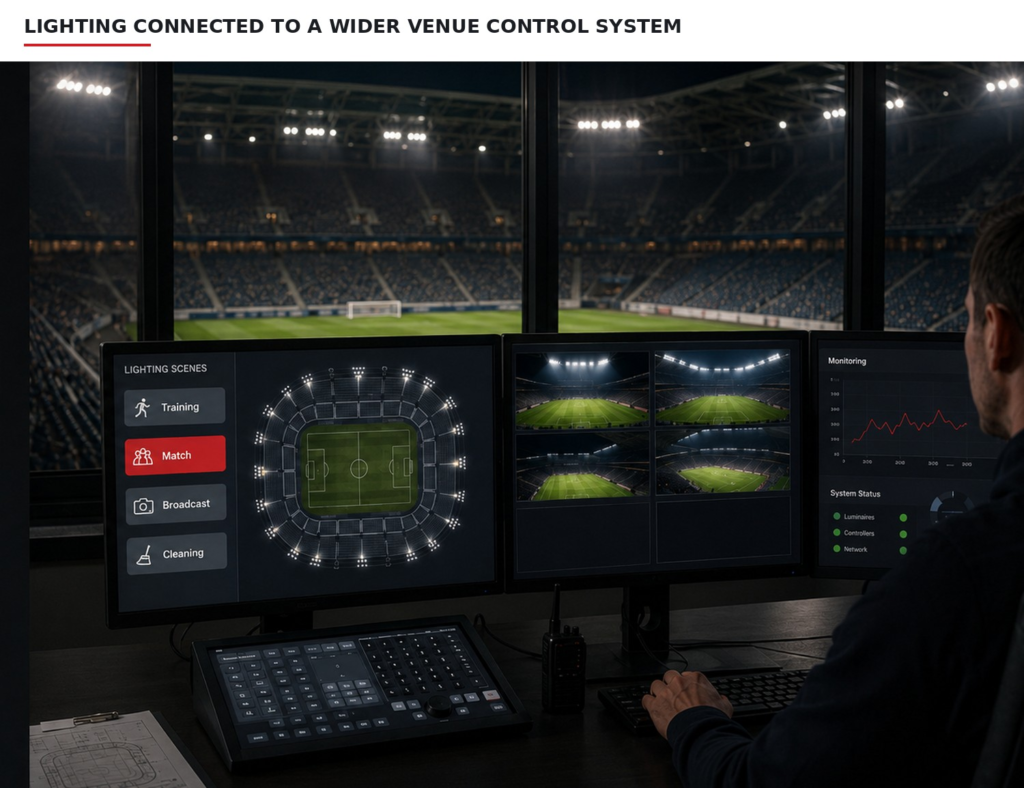
体育场照明灯具可通过兼容的接口和预设的运行场景,连接到更广泛的场馆控制系统。.
7. 在实际环境中评估性能
同一款灯具在干燥的内陆体育场、沿海场馆、粉尘较多的工业体育综合体或高温地区,其性能表现可能有所不同。产品选型应充分考虑实际现场环境。.
沿海和腐蚀性环境
应全面审查整个防腐蚀系统,而不仅仅是盐雾试验的持续时间。.
- 外壳和支架材料
- 涂装体系与预处理
- 紧固件材料
- 异种金属接触
- 驱动器外壳和连接器保护
- 排水、清洁和维护要求
高温区域
请结合实际的电气和热工条件,核对规定的额定工作温度。.
- 驾驶员体温限制
- LED的工作条件
- 热降额
- Enclosure configuration
- Expected daily operating hours
- Test conditions behind lifetime claims
Dusty or polluted sites
Check how contamination affects ingress protection, optics, heat dissipation, and cleaning.
- Ingress protection
- Lens and glass cleaning access
- Heat-sink orientation
- Dirt accumulation
- Sealing details
- Maintenance intervals
Lightning- and surge-prone locations
A coordinated surge-protection strategy may be required at several levels rather than relying only on a component inside the luminaire.
- Electrical distribution
- Grounding system
- Cable route
- Site exposure
- Luminaire-level SPD
- Distribution-level SPD and local requirements
| Coastal Corrosion for Stadium and High-Mast Lighting Surge Protection for Stadium and High-Mast Lighting What Long-Term Testing Reveals That Datasheets Don’t |
8. Consider Installation and Maintenance Before Ordering
Installation and maintenance are often considered too late in the project. Before selecting the product, confirm:
- How the luminaires will be lifted and handled
- Whether they arrive assembled or in separate modules
- How the bracket connects to the crossarm
- Whether drivers are installed on the fixture, bracket, pole, or ground
- How aiming angles will be recorded
- Whether visors can be installed before or after aiming
- How cables are routed and protected
- Which components can be replaced
- How much access is required for future servicing
- Whether the supplier provides aiming tables and luminaire IDs
A product that is easy to transport but difficult to assemble at height may increase installation time. A remote-driver design may reduce mast load and make driver servicing easier, but it requires proper cable design, enclosure placement, and installation coordination. A modular system can support flexible packaging and spare-part replacement, but installers need clear module assembly, wiring, torque, and aiming instructions.
| Sports Lighting Installation Guide Reducing On-Site Risks in Stadium Lighting Delivery Stadium Lighting Commissioning Sequence Stadium Lighting Sign-Off Pack |
9. Ask for Engineering Evidence, Not Just Specifications
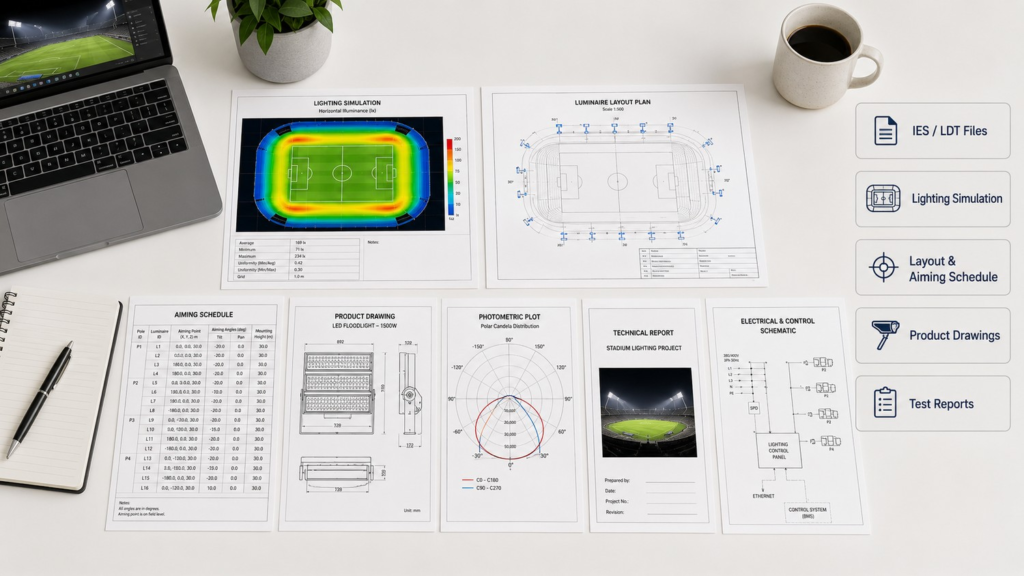
A specification sheet is useful, but it is not sufficient evidence that a product will meet the project requirements. Ask the supplier to provide the documents relevant to the actual project.
| Document | Why it matters |
| IES or LDT photometric file | Allows the exact product and optic to be used in the lighting calculation |
| Independent photometric report | Supports lumen, efficacy, power, color, and distribution claims |
| Project-specific lighting simulation | Shows expected field results for the proposed geometry |
| Luminaire layout | Identifies fixture quantities, positions, and optical distributions |
| Aiming schedule | Provides fixture IDs, target directions, and aiming angles |
| Product drawing | Supports structural, installation, and clearance review |
| Weight and EPA information | Supports mounting-structure evaluation |
| Electrical and driver data | Supports circuit and control-system design |
| Environmental test evidence | Supports protection, corrosion, thermal, and reliability claims |
| Control documentation | Confirms protocol and operating compatibility |
| Warranty terms | Defines coverage, exclusions, replacement process, and responsibilities |
| Relevant project references | Shows experience in comparable applications |
| Commissioning support plan | Clarifies how the installed system will be checked and accepted |
The submitted files must match the actual model, wattage, LED configuration, optic, driver, and control option offered for the project. A report for a similar product is not necessarily evidence for the exact configuration being supplied.
10. Common Stadium-Light Selection Mistakes
Mistake 1: Choosing by wattage alone
A 1,000W fixture is not automatically suitable for every field that previously used a 1,000W or 2,000W HID fixture. Useful performance depends on optics, geometry, aiming, and system efficiency.
Mistake 2: Comparing only maximum lumens
Maximum lumens do not show where the light goes. Compare project simulation, uniformity, glare, spill, vertical illuminance, and maintained performance.
Mistake 3: Using one beam angle across the entire field
Near, middle, and far zones usually have different optical requirements. One distribution can create hot spots, dark areas, overshoot, or unnecessary glare.
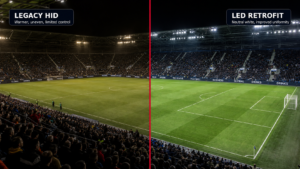
Mistake 4: Replacing HID fixtures one-for-one without recalculation
A physical one-for-one replacement does not guarantee equivalent field performance. LED and HID luminaires differ in optical distribution, dimensions, projected area, weight, and aiming behavior.
Mistake 5: Ignoring vertical illuminance
A field can appear bright from above but still provide weak visibility of players from spectator or camera directions.
Mistake 6: Reusing poles without structural review
Existing poles may have corrosion, undocumented modifications, limited capacity, or mounting configurations that are unsuitable for the proposed LED assembly.
Mistake 7: Accepting “flicker-free” without test conditions
Temporal light performance can change with driver selection, dimming level, supply conditions, and camera settings. Define the test conditions and evidence required.
Mistake 8: Selecting the lowest fixture price
Installation, structural modification, fixture quantity, energy use, driver replacement, lifting access, downtime, commissioning, and warranty execution all affect total cost.
11. Match the Fixture Type to the Project
The following table is not a product ranking. It shows how different product structures can match different project requirements. Final selection must use the latest approved datasheet and a project-specific lighting calculation.
| Project requirement | Characteristics to prioritize | ZC Lighting examples to evaluate |
| Professional and broadcast stadiums | High output, precise long-distance optics, color and temporal-light options, flexible controls | FL09, FL18, FL10 |
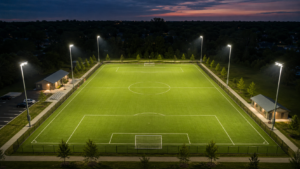
| Mid-sized fields and club venues | Balanced output, multiple optics, practical installation, controlled project cost | FL19, FL16, FL08, FL26 |
| Modular and scalable systems | Multiple module configurations, flexible power and optical combinations, easier shipping | FL07, FL15, FL26 |
| Existing-pole retrofit | Manageable mounted assembly, suitable EPA, flexible driver placement, compatible brackets | FL19, FL09, FL26 |
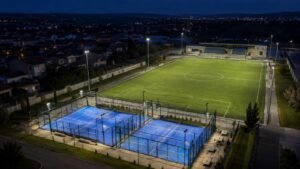
| Tennis and padel courts | Court-oriented optics, glare management, backlight and spill control | PL08 |
| Strict uplight or boundary control | Full-cutoff or tightly controlled optical distribution | FL20 |
12. LED Stadium Lighting Project Input Checklist
Providing complete project information helps the supplier recommend the correct luminaire, optic, quantity, and mounting arrangement.
| Required information | Project input |
| Sport and venue type | |
| Training, competition, or broadcast level | |
| Field dimensions | |
| Required standard or lighting class | |
| Required horizontal illuminance | |
| Required vertical illuminance | |
| Required uniformity | |
| Glare or spill-light restrictions | |
| 电线杆数量及位置 | |
| 杆高 | |
| Pole setback | |
| Existing or new poles | |
| Roof-mounted or pole-mounted | |
| 输入电压和频率 | |
| Required control interface | |
| Required operating scenes | |
| Temperature and environmental conditions | |
| Nearby residential or sensitive areas | |
| Installation schedule | |
| Available drawings or site photos |
常见问题解答
How many watts should an LED stadium light be?
There is no standard wattage that fits every stadium. Required wattage depends on field size, target lighting level, pole height, setback, fixture quantity, optical distribution, maintenance factor, and required uniformity. Finalize wattage after a project-specific lighting simulation.
Is a higher lumen output always better?
No. Higher lumen output is useful only when the optical system delivers the light to the required areas. A lower-output fixture with a more suitable distribution may produce a better field result than a higher-output fixture with poor beam control.
What beam angle is best for stadium lighting?
Most stadium projects require more than one optical distribution. Narrow distributions may be used for distant zones, while medium, wider, or asymmetric distributions may suit near zones, intermediate areas, and sidelines.
Are modular or integrated stadium lights better?
Neither is universally better. Integrated luminaires can simplify assembly, while modular systems can provide flexible power, optics, packaging, and maintenance. The best structure depends on mounting capacity, project scale, installation method, shipping, and service requirements.
Can LED stadium lights reuse existing poles?
Possibly, but the poles, foundations, crossarms, connections, and mounting arrangement must be evaluated. Fixture weight alone is not enough; EPA, center of pressure, wind, corrosion, and structural capacity also matter.
Do professional stadium lights need flicker control?
Projects involving professional broadcast, slow-motion recording, or high-speed cameras normally require defined temporal-light performance. The specification should identify the test method, driver configuration, load condition, dimming level, and acceptance requirements.
What should be included in a stadium lighting quotation?
A useful quotation should identify the exact luminaire, wattage, optics, quantity, driver and controls, mounting accessories, dimensions, weight and EPA, photometric files, preliminary lighting results, warranty terms, exclusions, delivery, and commissioning responsibilities.
How should two stadium-lighting proposals be compared?
Compare the complete systems under the same project requirements. Review field performance, quantity, optics, glare, structural impact, controls, installation, maintenance, technical evidence, and total project cost—not only fixture price, wattage, or lumens.
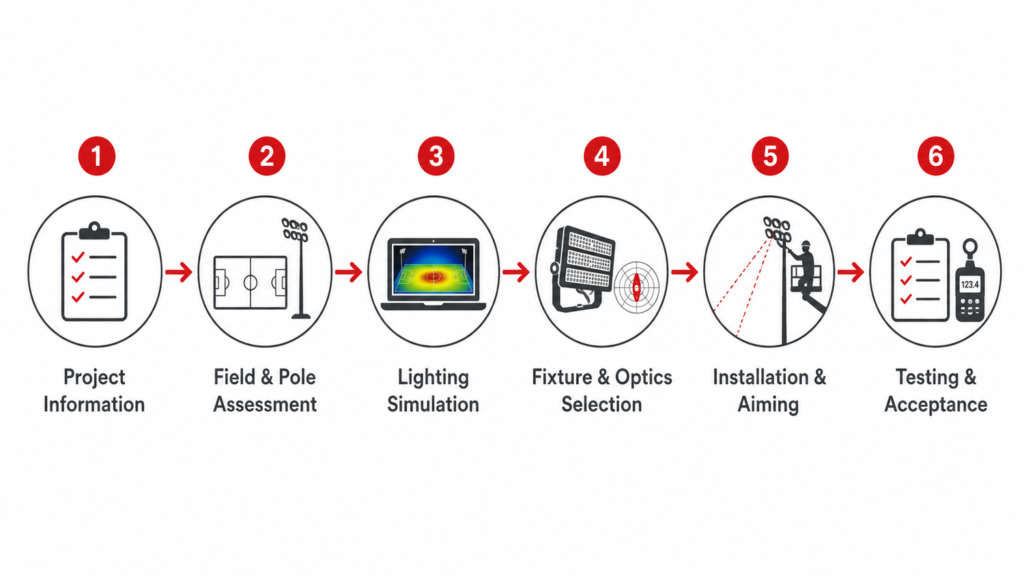
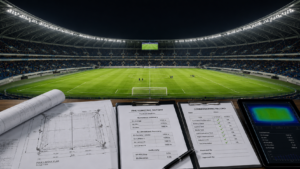
A practical selection workflow from project inputs and field assessment through simulation, fixture selection, installation, aiming, testing and acceptance.
结论
Choosing an LED stadium light begins with understanding the project—not with selecting a wattage. A reliable decision connects venue level, field geometry, photometric requirements, optical distribution, fixture architecture, structural conditions, electrical and control compatibility, environmental reliability, installation and maintenance, and project-specific verification.
The best stadium light is not necessarily the product with the highest output or the longest specification sheet. It is the product—and the complete lighting layout—that delivers the required visibility, uniformity, glare control, reliability, and operating performance under the actual conditions of the venue.
| Need Help Selecting the Right Stadium Light? Send us your field dimensions, pole layout, mounting height, target lighting level, and project requirements. ZC Lighting can help evaluate suitable fixture types, optical distributions, and a preliminary lighting layout for your sports lighting project. PRIMARY CTA: Request a Lighting Recommendation SECONDARY CTA: Download the Project Input Checklist Project drawings, pole layouts, site photos, and existing lighting information can be sent to info@zcled.com. |
 English
  한국어
한국어  Español
  简体中文
简体中文  Français
  Deutsch
  العربية
  日本語
日本語