
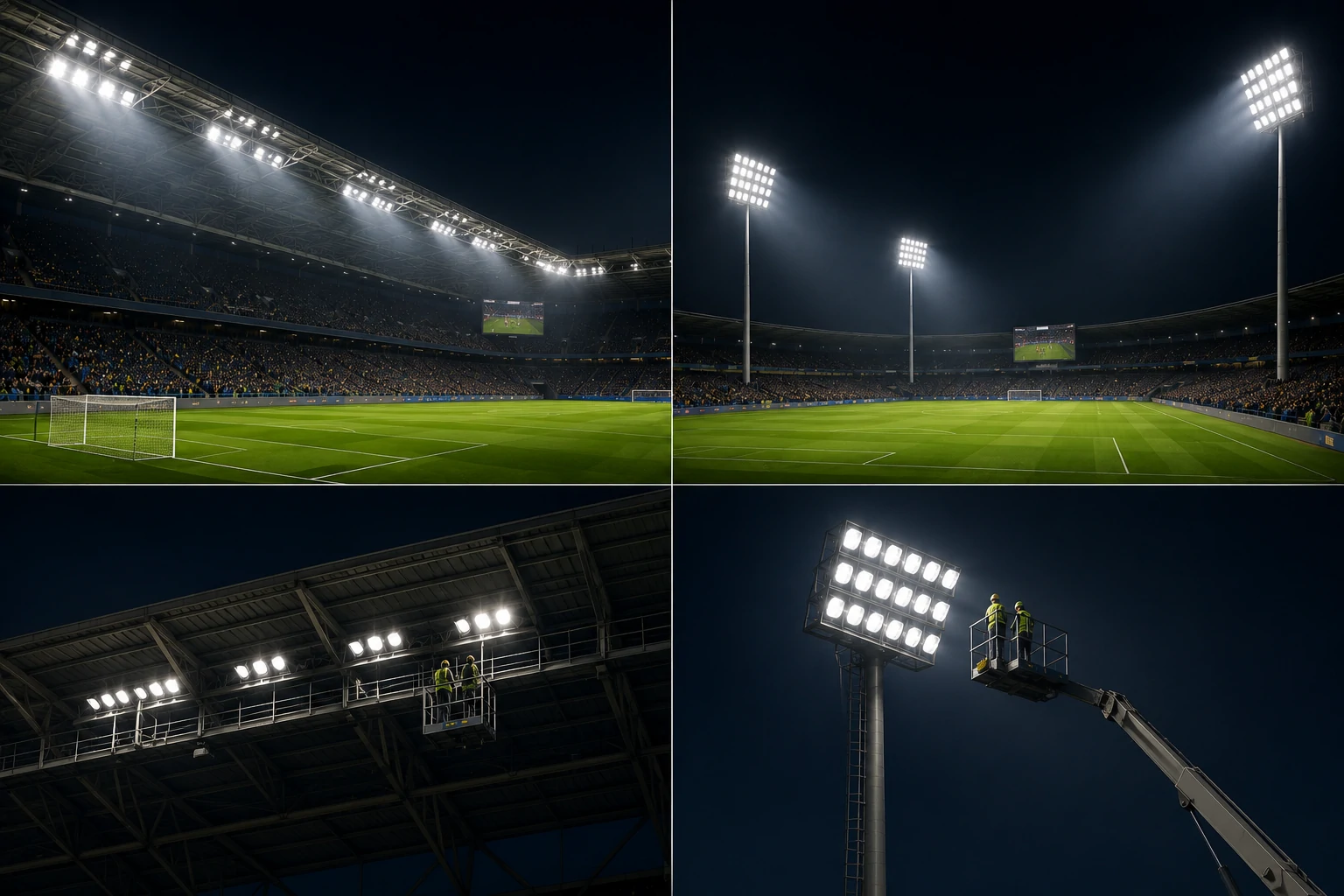
Mounting choice affects everything: structure, aiming, spill control, and long-term maintenance cost. This guide gives a fair comparison framework and the evidence to request so the project remains buildable and maintainable.
- Point clé #1 : Roof-mount can be elegant but can hide structural and access risks.
- Point clé #2 :Pole-mount often wins on aiming flexibility and serviceability.
- Point clé #3 :Define evidence early to avoid redesigns and handover disputes.
Table des matières
Dans les cas suivants
Use this guide when selecting mounting strategy for new stadiums or retrofits with existing grandstand/roof structures.
Typical scenarios
- New builds: you can design structure and routes for the lighting from day one.
- Retrofits: roof capacity and cable paths may be constrained.
- Neighbor-sensitive sites: mounting geometry affects glare/spill angles.
- High access cost: maintenance strategy can dominate TCO.
Exigences clés / indicateurs clés
Use these metrics to compare mounting options in a buildable and maintainable way.
| Factor | Quelles sont les conséquences ? | Pourquoi est-ce important ? | What to verify |
|---|---|---|---|
| Structural capacity | Safety and approvals. | Roof structures require verification. | Structural confirmation / check request. |
| Aiming geometry | Glare/spill risk. | Bad geometry forces high tilt. | Max tilt policy + aiming table. |
| Cable routing | Buildability. | Hidden routes create delays. | As-built route records and diagrams. |
| Maintenance access | Lifecycle cost. | Access is the real cost driver. | Access plan + SOP + spare strategy. |
| Commissioning evidence | Acceptance and disputes. | Fixed poles limit options. | Aiming table + photos + deviation log. |
Definitions
Roof-mounted lighting attaches to roof/truss structures; pole-mounted lighting uses standalone poles around the field. The best choice depends on structure, aiming geometry, and lifecycle maintenance access.
Practical targets
Typical guidance (always follow tender text):
- Roof-mount must have confirmed structural capacity and defined cable pathways
- Pole-mount must validate spill/glare and aiming within defined tilt limits.
- Both need an access/maintenance plan and an auditable sign-off pack.
Déroulement étape par étape
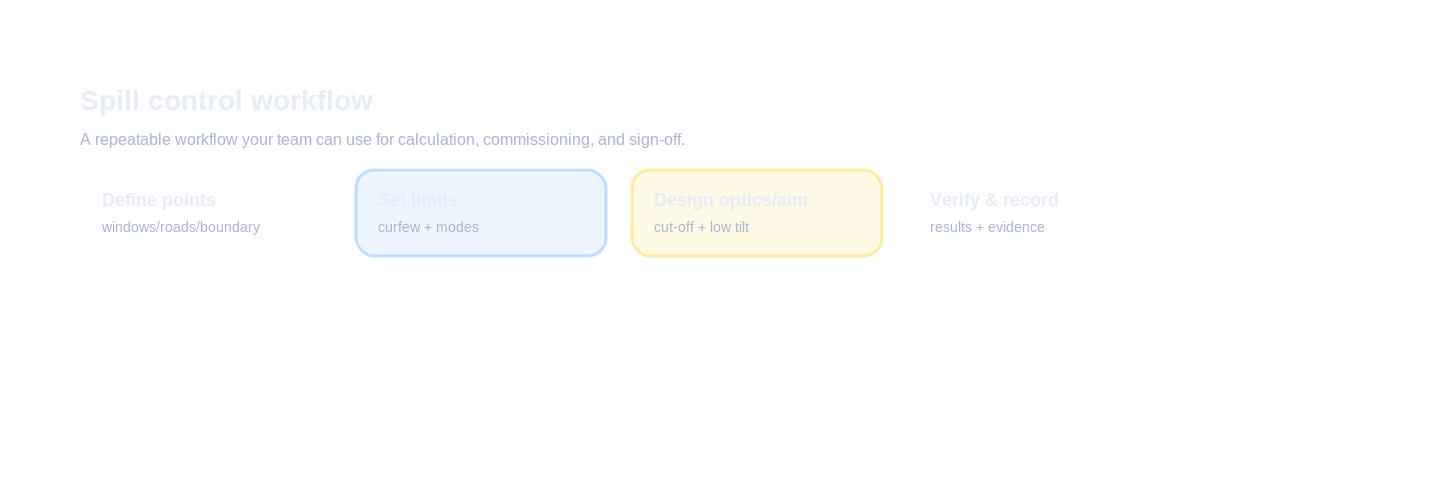
Workflow: define tier → map constraints → test 4/6/8 pole options in calculation → choose option with best risk profile → lock aiming limits and sign-off deliverables.
Inputs to collect
- Roof structure drawings (if roof-mount) or pole constraints (if pole-mount).
- Site boundaries and spill/glare constraints.
- Access method and safety rules.
Design decisions
- Select mounting option based on buildability and maintenance, not only aesthetics.
- Define aiming policy and verify through calculation.
- Define evidence pack requirements at handover.
Verification & sign-off
- Structural confirmation (roof-mount), aiming table, as-built routes, and SOP.
Erreurs courantes
- No structural confirmation for roof-mounted projects
- No access plan (maintenance becomes a crisis later).
- Ignoring glare angles created by roof geometry.
- No as-built route documentation.
Liste de contrôle / Téléchargement du modèle
These downloads are generated in-browser (TXT/CSV) and can be replaced later with gated assets.
Roof vs Pole Decision Checklist (CSV)
Compare structure, lighting, and O&M impacts.
Access & Maintenance Plan (TXT)
Define safe access and service method.
As-built Route Record (CSV)
Record cable/route pathways for maintainability.

 English
  한국어
한국어  Español
  简体中文
简体中文  Français
  Deutsch
  العربية
  日本語
日本語